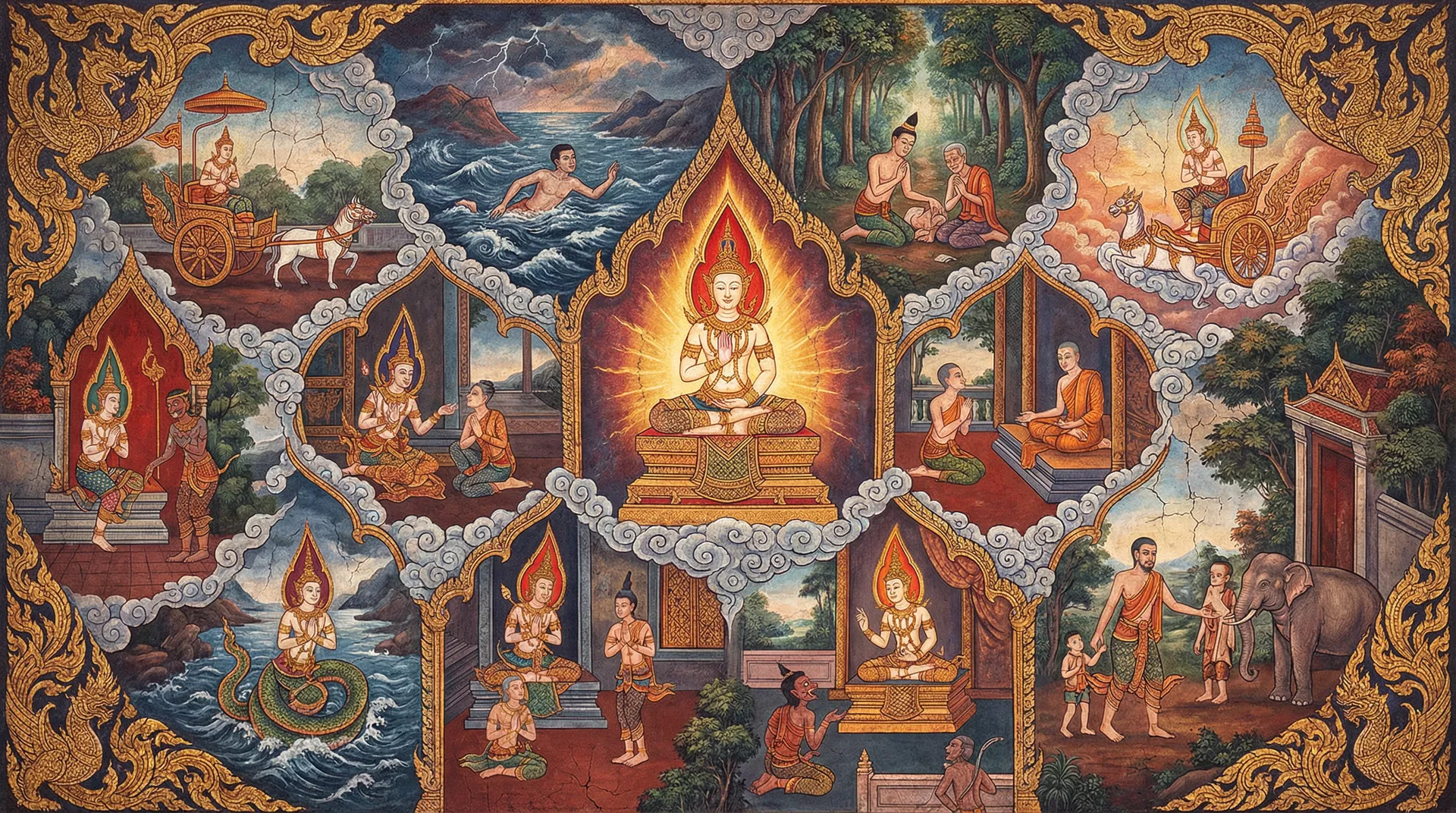
Mahā-janaka Jātaka
The Great Janaka
In the ancient kingdom of Mithila, nestled amidst lush gardens and bustling marketplaces, lived a wise and benevolent king named Janaka. His reign was a golden age, marked by justice, prosperity, and profound peace. Yet, even in this idyllic land, shadows of doubt could flicker. Janaka, though content, often pondered the true nature of happiness and the fleeting essence of worldly pleasures. He sought wisdom not from dusty scrolls, but from the very fabric of life itself.
One day, a renowned sage, his beard a cascade of silver and his eyes holding the depth of ancient forests, arrived at the royal court. He spoke of a distant land, a realm of unparalleled beauty and tranquility, where a sacred lake lay, its waters said to possess the power to reveal the purest form of bliss. Intrigued, King Janaka, accompanied by his loyal advisor, a man whose wisdom was as sharp as a freshly honed blade, embarked on a journey, leaving the affairs of the state in capable hands.
Their path was long and arduous, winding through dense jungles where unseen creatures rustled and across barren plains where the sun beat down relentlessly. They encountered merchants with tales of far-off lands, ascetics who practiced extreme self-denial, and hermits who found solace in solitude. Each encounter offered a glimpse into different philosophies, different pursuits of happiness.
Finally, after many moons, they reached the edge of a vast, shimmering lake. The air was filled with a sweet, intoxicating fragrance, and the water glowed with an ethereal light. As King Janaka gazed into its depths, a vision unfolded before him. He saw himself, not as a king adorned in jewels, but as a humble traveler, lost and adrift in a tumultuous ocean. The waves crashed around him, threatening to engulf him, and despair gnawed at his soul.
He struggled, his limbs weary, his spirit faltering. He cried out for help, but no one answered. The vastness of the ocean mirrored the vastness of his own fear. Just as he felt himself succumbing to the darkness, a tiny island, barely visible on the horizon, appeared. With a surge of renewed hope, he swam towards it, his every stroke a testament to his will to survive. He reached the shore, collapsing in exhaustion, only to realize that the island was not a sanctuary, but a mirage, fading with his every breath.
The vision shifted. He saw himself again, this time not fighting the waves, but accepting them. He stopped struggling, letting the currents carry him, observing them with a calm detachment. He realized that the struggle itself was the source of his suffering. By relinquishing the desperate need to control his fate, he found a strange sense of peace. He understood that even in the midst of chaos, serenity could be found within.
The vision faded, leaving King Janaka breathless and profoundly changed. He understood now. True happiness wasn't found in external circumstances, in palaces or riches, but in the inner disposition of the mind. It was about accepting what cannot be changed, about finding strength in surrender, and about cultivating a peace that no storm could ever extinguish.
Returning to Mithila, King Janaka ruled with a newfound clarity. He no longer clung to the trappings of royalty with the same intensity. He taught his people that true wealth lay not in possessions, but in contentment, and that the greatest battle was the one fought within oneself. His kingdom flourished not just in material prosperity, but in the spiritual well-being of its citizens. The Great Janaka became a legend, his story a beacon of wisdom for generations to come, reminding all that the truest bliss is an internal sunrise, a peace that originates from within, unperturbed by the external tides of fortune.
— In-Article Ad —
💡Moral of the Story
True happiness and peace are found not in external circumstances, but in the inner state of one's mind, through acceptance and inner strength.
Perfection: Wisdom (Prajna)
— Ad Space (728x90) —
More Jataka Tales You May Enjoy
 157Dukanipāta
Sasa Jataka
Sasa JatakaLong, long ago, in a time when the stars seemed closer and the moon cast a gentler glow, ...
💡 True virtue lies not in what one possesses, but in the willingness to give selflessly for the benefit of others.
 130Ekanipāta
Samkhapala Jataka
Samkhapala JatakaIn a time long past, when the mighty Himalayas stood as silent sentinels of the ear...
💡 True wealth is not measured by material possessions, but by inner virtues such as wisdom, compassion, contentment, and a life lived in harmony with the natural and spiritual order.
103EkanipātaMora Jātaka
The Golden Peacock's Plea In the heart of a vast and ancient forest, where emerald canopies kissed t...
💡 True beauty and value are best appreciated in their natural state. Possessing something or someone against their will diminishes its essence and leads to suffering, both for the captive and the captor. Freedom and dignity are paramount.
72EkanipātaThe Golden Elephant Jataka
In a tranquil land, blessed with lush forests and a clear, flowing river, lived a herd of wild eleph...
💡 Wisdom is found in careful observation, unbiased listening, and the humility to admit one's mistakes.
137EkanipātaMaha-Ummagga Jataka
The Great Wisdom of Prince VessantaraIn the ancient kingdom of Kalinga, famed for its glittering cit...
💡 The highest form of generosity is to give even that which is most precious, understanding that true happiness lies in selfless giving and compassion for all beings.
106EkanipātaBhaddasala Jataka
The Tale of the Wise Elephant and the Foolish King In the ancient kingdom of Mithila, ruled a king n...
💡 True wisdom often comes from unexpected sources. A leader's true strength is shown not in anger or pride, but in humility, compassion, and the willingness to serve their people.
— Multiplex Ad —